21-day birding trip North-East South Africa

Updated: Aug 13

Day 1 – 19 February 2026
After Rein had spent a few days with us together with his family in 2024, something kept bothering him. During the rest of that trip, he had missed several true target species. That had to change. Before long, the idea for a new trip was born — this time completely focused on birds and cats. Not much later, work began enthusiastically on a new itinerary. Different areas were considered, chances for desired species were discussed, and slowly but surely the trip started to take shape. Once the program had finally been put together and fine-tuned down to the smallest details, only one small challenge remained: finding two additional travel companions. Fortunately, that did not take long. Gijsbert Twigt and Paul Rhodes soon joined, completing our team.
On 19 February 2026, the time had finally come: the adventure could begin. At the hotel, the luggage was quickly loaded into the car and not long afterwards we left Johannesburg behind us. Our first destination was Marievale Bird Sanctuary, just outside the bustle of the big city. Marievale lies about an hour east of Johannesburg and consists of vast reedbeds, shallow pans and open water. It is known as one of the best birding sites in Gauteng, especially for waterbirds, waders and reed-dwelling species.
We too got off to a flying start. We had barely arrived when we were treated to a wonderful sighting of a Marsh Mongoose foraging along the water’s edge, an unexpected but very welcome start to the trip. Meanwhile, our species list quickly began to grow with birds such as Long-tailed Widowbird, Blue-billed Teal, Black Heron and, to our surprise, our only Greater Flamingo of the entire journey.
Around 11:00 it was time to leave Marievale behind. A long drive still awaited us towards Underberg. Naturally, we kept our eyes open along the way, and from the car we were able to add several more species to the list, including Black-winged Kite, Southern Bald Ibis and South African Cliff Swallow.
At the end of the day, we happily reached our destination. The day was rounded off in style with a well-deserved braai and a cold beer, while we looked back with satisfaction on a first day during which the species list had steadily grown to nearly 60 species.
Day 2 – 20 February 2026
At 5:50 a.m. we were picked up by our local guide for the day. At several locations during this trip we make use of local guides. They know the area and the specific spots far better, allowing us to get much more out of the day and greatly increasing our chances of finding special species.
Today featured one of the absolute highlights of the trip: the famous Sani Pass. This spectacular 4x4 gravel road winds its way up through the Drakensberg Mountains via countless hairpin bends and eventually takes you quite literally into the clouds. The pass links South Africa with Lesotho and is regarded as one of the most impressive mountain passes in southern Africa.
Before beginning the real climb, we first did some birding along the roadside and were able to note the first species of the day, including Swee Waxbill, Bush Blackcap, African Firefinch, Dark-capped Yellow Warbler and Red-throated Wryneck.
After a short stop at the border control and the first stamps in our passports the real work could begin. The ascent of Sani Pass is always spectacular. Because Rein, Gijsbert and Paul have a strong interest in plants as well as birds, we soon found ourselves struggling slightly with the schedule. More than once I had to gently force them back into the vehicle so we could keep making progress. Even before reaching the summit and the border with Lesotho, we had already connected with two major target species: Drakensberg Rockjumper and Drakensberg Siskin. Fortunately, both showed very well and immediately became among the day’s highlights.
At the border post we were welcomed by a male Sentinel Rock Thrush singing beautifully from a rock. Once our passports had also been stamped there, we were able to enter Lesotho. Mountain Pipit, an endemic breeding visitor in the highlands of Lesotho, was thankfully found soon afterwards. A nice bonus was a soaring Verreaux’s Eagle, a species I do not often encounter here. Unfortunately, the weather was not entirely on our side. Cool temperatures kept some species rather inactive. Even so, before lunch we still saw an excellent range of birds, including Black-headed Canary, Fairy Flycatcher, Cape Rock Thrush and another pair of Ground Woodpeckers.
During lunch, however, came an unexpected highlight. Despite the gloomy weather, an adult Bearded Vulture suddenly appeared, seeking shelter along a large sheer rock face. An impressive sighting, and a species we had not really expected to see in such poor conditions. Meanwhile, dark clouds were gathering from every direction, slowly merging into one threatening blanket of cloud. We decided not to wait for the approaching storm and wisely began our descent. Barely back on South African soil, just before the rain started pouring down, we found our final target species of the day: Gurney’s Sugarbird. A perfect ending to a spectacular day on Sani Pass.
 |  |
Bush Blackcap | Drakensberg Rockjumper |
 |  |
Ground Woodpecker | Gurney’s Sugarbird |
Day 3 – 21 February 2026
After I had thrown all the luggage into the car, or so I thought, it was time to say goodbye to our first accommodation. Just outside Underberg, a short morning birding round was still on the agenda, in search of a few good species to start the day. It did not take long before we spotted a family of Wattled Cranes standing out in the fields. As I enthusiastically reached for my telescope, it suddenly dawned on me: my own luggage was still back at the accommodation. Fortunately, the cranes showed calmly, allowing us to enjoy them and take a few photos before we quickly drove back to collect my forgotten belongings.
With everything finally complete, we continued our morning round, which still produced several excellent species. Denham’s Bustard, African Marsh Harrier and Grey Crowned Crane could all be added to the list.
The next major target of the trip was Blue Swallow, a species that is sadly declining rapidly in its South African breeding areas. As with so many species, the main cause is the loss of suitable habitat. With a bit of anticipation, we drove to the site where a breeding pair was known to occur. But apparently something was in the air today… because at the exact moment we arrived, I realised that this time I had left my camera in the car. Naturally, this turned out to be the day the swallows showed at their absolute best. Again and again they swept past us at close range, glowing beautifully in the sunlight. Luckily, my travel companions were a great deal sharper than I was that day, and in the end they managed to capture a fine series of photographs. While waiting for the next spectacular flypast of the swallows, there was never a dull moment. Species such as Buff-streaked Chat, Yellow-crowned Bishop and Fan-tailed Grassbird, together with the wide-open scenery, provided more than enough distraction. Even on the walk back to the car, birds kept appearing, including Dark-capped Yellow Warbler, Olive Woodpecker, African Dusky Flycatcher, Cape Batis and Cape White-eye. After that, it was time to really get moving. The rest of the day was mainly focused on the drive to our next destination: Eshowe.
 |  |
Wattled Crane | Blue Swallow (Gijsbert Twigt) |
Day 4 – 22 February 2026
Today we were once again joined by a local guide, someone who knew the area like the back of his hand and would lead us to its hidden gems in search of the right species. We started the day in Dlinza Forest Reserve, where the dense forest immediately created a real sense of adventure. It did not take long before we connected with one of our targets. From the canopy tower we scanned the treetops, and there she was: a female Eastern Bronze-naped Pigeon, perched less than fifteen metres away. Perfectly close, yet so well hidden among the leaves that getting a truly clear view was still a challenge.
We then descended to the forest floor for our next mission: Spotted Ground Thrush. Carefully we moved through the forest, listening to every sound and searching for movement among the leaf litter. Before long we gained some unexpected company in the form of a Blue Duiker. The tiny antelope seemed determined to join us, following us everywhere and regularly causing small heart attacks whenever something moved in the undergrowth. At one point Rein and I saw a bird disappear behind a fallen tree. From then on, a real game of cat and mouse began. Every now and then Gijsbert picked it up glowing briefly in the vegetation with his thermal scope, but apart from a wing showing the species’ distinctive two white stripes, we never managed a proper view. Before we had fully processed that frustration, we were already involved in the next hide-and-seek game — this time with a juvenile and an adult Crowned Eagle. Every time we thought we had them well in view, they were just one step ahead of us again.
Our next destination was a small clear pool covered with water lilies, hidden in the middle of a vast eucalyptus plantation. On the way there we were already surprised by a loudly calling Black Coucal showing off from the top of a bush. At the pool itself things moved quickly: within minutes we had added Eurasian Honey Buzzard, Red-headed Quelea, White-backed Duck and African Pygmy Goose to the list.
But the day was far from over. We continued to Ngoye, a patch of rainforest just north of Eshowe. These small islands of forest are very special, as they are the only place in southern Africa where Green Barbet occurs, naturally one of our main targets. Although we occasionally heard it calling from deep within the forest, the bird itself remained invisible. Thankfully, while we waited, other species showed well, including our first Green Twinspots and Lemon Doves of the trip. Fortunately, we still had a Plan B. After about an hour we decided to take a 4x4 track to another section of forest. It proved to be a golden move. Less than ten minutes in, a Black-rumped Buttonquail suddenly flushed from the track ahead of us. Every now and then it dashed through an opening in the vegetation, just long enough for us to enjoy good views. A little later we reached the new patch of forest, and this time it did not take long. There he was at last: a Green Barbet, calling loudly above our heads. On the way back, it briefly seemed as if we had flushed another Black-rumped Buttonquail. But thanks to Gijsbert’s quick reflexes, managing to grab a few photos immediately, it turned out on closer inspection to be a Common Buttonquail instead. During the first days of the trip, we had been lucky that the rain usually fell at just the right

moments. Today, however, fortune had shifted. Back in Eshowe we wanted to make one final attempt for Spotted Ground Thrush, but the rain
became heavier and heavier, and eventually we had to throw in the towel.
Green Barbet
Day 5 – 23 February 2026
In the morning we paid one final visit to Dlinza Forest. Our hopes were set on improved views of both Spotted Ground Thrush and Crowned Eagle. Unfortunately, the forest proved less generous this time and there was no sign of either species. During a short circuit through the reserve, however, we were still rewarded with several excellent birds, including Blue-mantled Crested Flycatcher, Lemon Dove and Olive Bushshrike.
Afterwards we drove once more to Mtunzini for a final attempt at finding Palm-nut Vulture. Luck was not on our side there either, and we had to leave this species on the wish list for the time being. We then continued towards St. Lucia, our base for the next two nights.
Upon arrival, we first took some time to relax by the swimming pool at our accommodation. While sitting there, Trumpeter Hornbills regularly flew overhead, calling loudly as they passed. Toward the end of the afternoon we headed into the forest south of the village with a local guide. Via narrow trails we entered the dense coastal forest and soon found ourselves in the middle of a lively mixed feeding flock. It was a come and go of lovely species, including Woodward’s Batis, Red-fronted Tinkerbird, Rudd’s Apalis, Yellow-breasted Apalis, African Paradise Flycatcher and Terrestrial Brownbul. After some patient searching high in the dense canopy, we were eventually rewarded with two Livingstone’s Turacos, keeping well hidden but still giving us satisfying views.
After dinner, one final activity was still on the agenda. We went in search of our
first owl of the trip: Wood Owl. Fortunately, it did not take long to find, and we enjoyed
excellent views. Encouraged by this success,

we drove a little way outside the village to look for other nocturnal wildlife. This produced fine sightings of at least two Large-spotted Genets and a family of Thick-tailed Bushbabies, moving agilely
through the trees. African Wood Owl
Day 6 – 24 February 2026
At first light we entered the Eastern Shores section of the iSimangaliso Reserve, just north of St Lucia. Today our focus was not only on birds, because from this point onward we also had a serious chance of encountering our first big game of the trip. And that did not take long. Barely underway, we were welcomed by a lone male Cape Buffalo calmly grazing among the water lilies. Not much later we added Hippopotamus, Burchell’s Zebra and Greater Kudu. In terms of birds, especially waterbirds, the park felt surprisingly quiet. Perhaps the effects of the cyclone that had swept through the north-east of the country a month earlier were still noticeable. Even so, there was plenty to enjoy. Among the species we recorded were Southern-banded Snake Eagle, White-backed Duck, Blue-cheeked Bee-eater and Striped Kingfisher. At Cape Vidal we took a short walk in the hope of a few extra surprises, but apart from a troop of Samango Monkeys things remained fairly quiet. Afterwards we slowly made our way back to the accommodation for a short break before the second half of the day.
In the afternoon we walked along a boardwalk through the mangroves to the estuary, where the lagoon lies in open connection with the Indian Ocean. Here too, life seemed somewhat subdued. While scanning the terns, a Osprey suddenly glided low past the reedbeds. On the sandbanks gathered Common, Lesser Crested, Swift and Little Terns, while along the muddy edges small groups of waders were feeding: Little Ringed Plover, White-fronted Plover, Eurasian Whimbrel, Grey Plover and Common Greenshank.
As we walked back, Gijsbert and Paul decided to check the terns one last time, while Rein and I tried to explain to two lost tourists how to get back to the village. Right in the middle of our explanation, shouting suddenly erupted from the beach. Gijsbert and Paul were jumping wildly and pointing out to estuary mouth. Without hesitation, we abandoned the tourists and ran over. Just off the outflow channel, a Bull Shark of well over 4.5 meters was actively hunting. Whether the lost tourists eventually found their way back to the village, or are still wandering the beach to this day, we will probably never know.
Dag 7 – 25 februari 2026
After visiting the Eastern Shores yesterday, it was time for the Western Shores this morning. We would drive through this section of the park on our way to the next destination. The day began immediately on a promising note with a Corn Crake calmly walking across the road, only to flush moments later and vanish like a ghost into the tall grass. Not much farther on came the next excellent surprise: a female Saddle-billed Stork feeding while partly hidden in the high vegetation. Raptors were especially impressive in this part of the park. Among the species we saw were Eurasian Hobby, African Marsh Harrier, Long-crested Eagle, Black-chested Snake Eagle and Martial Eagle. Other highlights included Collared Pratincole and Broad-billed Roller.
After a short drive we arrived at Mkhuze Game Reserve, our base for the next two nights. Once checked in, we of course immediately did some birding at the hide next to reception. That quickly produced Black-capped Bulbul, Crested Barbet and Spectacled Mousebird. Afterwards we decided it was high time for an ice-cold and well-earned beer at our tents. But rest never lasts long on a trip like this. During our short break, news came through of a Secretarybird not far outside the camp. As this species ranked high on the wish list, we jumped straight into the car and headed off at speed.
When we arrived, however, there was no sign of the bird. Or perhaps that was because our attention was instantly captured by something else standing in exactly the same spot: an impressive Black Rhinoceros calmly feeding on fresh growth right beside the road. For half an hour we enjoyed this incredible sight until it slowly crossed the road and disappeared into the dense vegetation. Still full of adrenaline, and with barely an hour left before gate closing time, we continued on. That final hour proved golden, producing new species such as Long-tailed Paradise Whydah, Chestnut-backed Sparrowlark, Common Scimitarbill and Southern Black Tit. Back at the tents, a fire was quickly lit for the braai, while the last remaining daylight was used to the fullest. This added Black Cuckooshrike, Orange-breasted Bushshrike and Chinspot Batis. During a wonderful braai we were distracted one final time when a Thick-tailed Bushbaby nimbly climbed down via the kitchen railing.
 |  |
Long-crested Eagle | Black Rhinoceros |
Day 8 – 26 February 2026
We started the day with a walk through a beautiful Fig Tree Forest, in search of the legendary Pel’s Fishing Owl. An extremely shy and elusive species, perfectly adapted to dense riverine forests, where it hides in thick branches above the water close to its favorite fishing spots. Unfortunately, the owl did not reveal itself this morning, but there was certainly no shortage of activity. The fig trees were heavily laden with ripe fruit and attracted a constant stream of birds, creating a true feeding spectacle with African Green Pigeon, Trumpeter Hornbill, Red-collared Barbet, Dark-capped Weaver and many more.
We ended the morning with a circuit of several hides and viewpoints. Hardly had we driven off when three Broad-billed Rollers flew over the road, slightly closer than in the Western Shores, although still partially obscured by branches. At the first stop we were immediately treated to two excellent flybys: first an impressive African Fish Eagle, followed shortly after by two Pink-backed Pelicans. This species was once abundant here but has unfortunately declined significantly in recent years. As temperatures rose, one of the waterholes became a magnet for thirsty birds. It was a constant flow of activity with Green-winged Pytilia, Grey Waxbill, African Paradise Flycatcher, Purple-crested Turaco and many others coming in to drink.
After taking a break during the hottest hours of the day, we prepared for a final afternoon push. But we were not the only ones struggling with the heat. Beneath almost every bush lay Blue Wildebeest or small groups of Impala seeking shade. While watching a Cardinal Woodpecker, a car suddenly pulled up beside us. With wide eyes, the driver told us that three lions were lying in the long grass just ahead. We decided to continue birding a bit longer first, hoping the lions would become more active later in the afternoon. Along the way we encountered several Palearctic migrants such as European Bee-eater, Red-backed Shrike and European Roller, and also improved earlier sightings of Chestnut-backed Sparrowlark and Rattling Cisticola. By then the lions had indeed woken up. In fact, one of the lionesses even attempted to charge one of the vehicles.
Day 9 – 27 February 2026
Before continuing our journey, we decided to make one final stop at our most successful bird hide of the past few days. And it turned out to be an excellent decision. Right in front of the hide stood a Dwarf Bittern, motionless along the water’s edge, before it eventually melted away completely into the dense vegetation. While we waited for more action, we were thoroughly entertained by the Grey Foam-nest Tree Frogs present around the hide. Along the path back to the parking area, however, came perhaps the most rewarding surprise of the morning. At last, we connected properly with a species we had only had brief glimpses of so far: Pink-throated Twinspot. A pair gave absolutely outstanding views and even offered a few photographic opportunities.
Around the parking area it suddenly felt like spring had arrived. Birds were singing at full volume from every direction, perhaps relieved that today was not as hot as the previous days. Along this morning we also enjoyed excellent views of Rudd’s Apalis, Common Scimitarbill, Grey-headed Bushshrike and the ever spectacular Gorgeous Bushshrike.
After this highly successful morning, a long drive towards Wakkerstroom lay ahead. In Pongola we quickly stopped at a supermarket to restock supplies. At Dirkiesdorp we then made an additional stop for White-bellied Bustard. Timing, however, could hardly have been worse, as the moment we left the main road heavy rain began to fall. Fortunately, the shower passed quickly, and it was Gijsbert who suddenly spotted a bird feeding in the long grass. With the help of the telescope, we eventually enjoyed superb views of two individuals.
On the way to the next field, we were treated to a brief but memorable bonus sighting: an Orange-breasted Waxbill perched fully exposed on a barbed-wire fence for barely three seconds before disappearing into the fields. Meanwhile, darker and more threatening clouds rolled in from behind the mountains. Just before the storm fully broke, we were given a spectacular farewell gift: a pair of Lanner Falcons performing beautifully against a backdrop of lightning flashes tearing through the sky.
 |  |
Purple-crested Turaco | Dwarf Bittern |
 |  |
Pink-throated Twinspot | Rudd’s Apalis |
Day 10 – 28 February 2026
At exactly 6:00 a.m. our guide for the day came walking towards us. After a quick round of introductions, we set off immediately. Against better judgement, we started with a brief attempt to find Red-chested Flufftail. After fifteen minutes surrounded by no fewer than four calling birds, without seeing a single glimpse, we eventually gave up and jumped back into the car.
In the morning we once again tried our luck in the fields around Dirkiesdorp. At the very first stop we immediately struck gold. In a small herb field, where several species of Cisticola were moving through the grass, we counted at least ten Cuckoo Finches. Fascinating birds that, like cuckoos, lay their eggs in the nests of other species, in this case mainly Cisticolas.
At the final field from the previous day we were meanwhile being closely watched by the local Lanner Falcons. While we were enjoying White-fronted Bee-eater, South African Cliff Swallow and African Black Duck, a beautiful Red-throated Wryneck suddenly landed in a bush right next to the car. What from a distance had looked like empty, lifeless grassland once again proved to be full of surprises. Yellow Mongooses were regularly darting across the road, and we recorded species such as Red-capped Lark, Pink-billed Lark, Spike-heeled Lark and Southern Bald Ibis. Perhaps the biggest highlight, however, was a much better sighting of a pair of White-bellied Bustards, which suddenly appeared right beside the vehicle.
As so often on a birding trip, the day simply did not have enough hours. We had to move on to our next destination: the higher altitude grasslands around Wakkerstroom itself. Along the gravel road towards Amersfoort we made stop after stop for Blue Korhaan, Blue Crane, Orange-breasted Waxbill and the always difficult Quailfinch, which this time showed exceptionally well. Before heading into the mountains for our final target species, we stopped at a waterbody that was absolutely packed with birds: Great Crested Grebe, Black-necked Grebe, White-backed Duck, Maccoa Duck and many more.
We ended the day with our local guide in the mountains, searching for Yellow-breasted Pipit, Eastern Long-billed Lark and African Rock Pipit. Fortunately, everything worked in our favour and we were able to return satisfied. After dropping the guide off at home, only one last mission remained: Marsh Owl. It initially seemed like a repeat of the previous day. Just as we arrived at the right spot, thunder began rolling in and hail started to fall. There was nothing left to do but turn around and head back to the accommodation. But would we really leave it at that? After a few hundred meters I firmly turned the wheel. We went back. Not even a massive and rare roll thunder the size of a beach ball appearing from under a tree could stop us anymore. And fortunately, it was the right decision. Back at the site, we were rewarded with exactly what we had hoped for: a spectacular show of no fewer than five Marsh Owls actively hunting over the fields.
 |  |
Lanner Falcon | Marsh Owl |
Day 11 – 1 March 2026
After a short delay caused by a flat tyre, we were finally able to set off. First, we made one last attempt for Red-chested Flufftails on the edge of the village. And this time we succeeded: eventually everyone managed to catch a glimpse of this shy and elusive skulker, a great boost to start the day and our dirty hands were quickly forgotten.
As we rejoined the main road on the far side of the village, we suddenly found ourselves surrounded by around 200 Amur Falcons perched on the electric wires. We had agreed beforehand that we would try to pick out at least one Red-footed Falcon among the flocks and then leave them undisturbed. After several unsuccessful scans over the previous days, it finally happened: an adult female was neatly picked out among the mass of falcons. Relief all around. Fortunately, we were right to be satisfied then and there, as the flocks only grew larger, and by the end of the day we had counted well over a thousand Amur Falcons.
The reason for leaving Wakkerstroom was just as exciting as the morning itself: we were on our way to the world-famous Kruger National Park, where we would spend the next two nights at Lower Sabie. Traffic was on our side, and around 13:00 we entered the park through Malelane Gate, full of anticipation. Due to the same cyclone that had hit in January, many gravel roads were unfortunately closed. However, one of the few roads still open was the S25, and we naturally seized the opportunity and drove it all the way to Crocodile Bridge. Along the way we saw plenty of elephants, leaving only leopard missing from our Big Five list. Meanwhile, temperatures had climbed to an extreme 47°C, making birding far from easy. Still, the surprises kept coming. Against all expectations, new species followed one another in quick succession: Red-crested Korhaan, Green Sandpiper, Peregrine Falcon, Purple Roller and Capped Wheatear, to name just a few.
At Crocodile Bridge we quickly stocked up on ice-cold drinks, as we still needed to make good time to reach camp. Moreover, there was one important stop en route. For the past week, two African Skimmers had been regularly seen on a sandbank near Lower Sabie, a species that was extremely high on all our wish lists. When the birds finally came into view, four deep sighs of relief filled the car. Mission accomplished. With a well-earned beer to toast the success, we drove the final stretch to camp, ready for whatever Kruger would still have in store for us.
 |  |
African Skimmer | Peregrine Falcon |
Day 12 – 2 March 2026
With big cats high on the wish list, we set off early in the morning, driving slowly along the Sabie River towards Skukuza. This stretch winds through a landscape of ancient giants, especially towering fig trees that provide perfect habitat for leopards. The anticipation was high, but no matter how carefully we scanned the branches and riverbanks, the elusive cat refused to show itself. Fortunately, there was plenty else to enjoy. Elephants appeared regularly from the bush, making their way down to the river for a drink, always special moments to witness at close range. A Speke’s Hinged Tortoise was a nice surprise, as Leopard Tortoises are far more common in this area. At a bridge over the Sabie River, we were suddenly greeted by a true giant: a Goliath Heron. Standing 1.5 metres tall, it loomed over the water’s edge, the largest heron in the world and an unforgettable sight in the soft morning light.
Before we could stretch our legs in Skukuza, more species kept adding to the list along the way, including Giant Kingfisher, African Cuckoo, White-crested Helmetshrike and Arrow-marked Babbler. From Skukuza we continued via Leeupan towards Tshokwane for lunch. Not even before reaching Leeupan, we hit another highlight: a small family group of Southern Ground Hornbills was actively hunting in the tall grass, effortlessly pulling up insects and larvae in a constant display of foraging skill. At Leeupan itself, things only intensified. A raptor suddenly lifted from around the pan and revealed itself as a Lesser Spotted Eagle. The pan held more water than I had seen here in years, attracting a great variety of waterbirds including African Jacana, Dwarf Bittern and White-backed Duck. In a dead tree standing in the water, Red-billed Buffalo Weavers were busy maintaining their nests. A brief moment of tension followed when an Olive-tree Warbler called from the thickets, but it remained stubbornly out of sight. We moved on, only to be stopped again shortly before Tshokwane, this time by a dramatic gathering of vultures circling overhead. The reason soon became clear: a dead elephant lay just off the road, surrounded by dozens of White-backed Vultures and a single Lappet-faced Vulture. A raw, powerful reminder of nature at its most honest.
I had been tipped off about a few productive spots along the S128 and S129, so we naturally gave them a try. Barely onto the S129, we found a Hamerkop feeding at a low-water bridge, while a Malachite Kingfisher scanned the water from a reed perch. At the S128 junction, things picked up again quickly. Lesser Moorhen, another Dwarf Bittern, and even our first Knob-billed Duck of the trip followed in quick succession. With time running out, we slowly began heading back towards camp, but of course not without one final scan from the bridge. Among crocodiles and hippos, we picked out Green-backed Heron, White-throated Swallow and Pied Kingfisher, rounding off yet another rich and unforgettable day in Kruger.
 |  |
Lesser Moorhen | Southern Ground Hornbill |
Day 13 – 3 March 2026
The early hours were, just like the day before, dedicated to slowly scanning the road along the Sabie River in search of cats and new species. Driving at a relaxed pace, we once again encountered plenty of highlights: Saddle-billed Stork, African Harrier-Hawk, Hooded Vulture and Green Wood Hoopoe all made for a strong start to the morning. The much-desired cats, however, remained as elusive as ever and once again refused to show themselves.
Before we had to continue our journey north, we made a short walk around Lower Sabie. There, we finally all managed brief but satisfying views of Olive-tree Warbler, a species that had been outsmarting us for days. Knowing that one of our target species was still waiting for us at the junction of the S128 and S129, we headed straight there. But as always in Kruger, distractions came around every corner. On the way we stopped for Black-crowned Tchagra, a Spotted Hyena moving casually among a Buffalo herd, two stately Secretarybirds striding through the grass, and much more besides. Along the S129, a Black Coucal was also perched in top of a bush, calling loudly right beside the road, a far better sighting than earlier in the trip.
Once we reached the S128, we went straight for our main target. The Lesser Moorhen was still in exactly the same spot with her chicks, and in a small bush within a marshy patch at least five juvenile Dwarf Bitterns were actively moving around. The first bonus of this stop came in the form of a male Greater Painted Snipe. Unlike most bird species, it is actually the female that is more brightly colored. As we scanned the lilies and grasses one final time, Gijsbert suddenly picked up a small rail walking through the vegetation. The moment I got it in the binos, I called immediately Spotted Crake. It turned out to be only the second record ever for Kruger, a truly exceptional find. And just when we thought things could not get better, the species we had actually came for finally appeared. At a long distance but unmistakably, there it was: our target, an Allen’s Gallinule. Two absolute megas in a single stop.
At the elephant carcass, the vulture spectacle was still in full swing, with hungry birds jostling for position. With far fewer vehicles around than the previous day, we were able to take our time and fully enjoy the raw scene. The only positive side of the road closures was that we had no real choices to make, we simply followed the tar road towards Orpen Gate. And it turned out to be anything but boring. Along the way we encountered an impressive Tawny Eagle, a Kori Bustard, the world’s heaviest flying bird and countless Bateleurs. At around 16:30 we left Kruger behind for now, with only a short hour’s drive remaining to Paradise River Lodge.
 |  |
Saddle-billed Stork | Secretarybird |
 |  |
White-fronted Bee-eater & Lesser Grey Shrike | Black Coucal |
Day 14 – 4 March 2026
Today was all about the Blyde River Canyon, the biggest green canyon in the world. Even before we had set off, we were already welcomed by an African Goshawk sitting proudly right above the car, as if seeing us off for the day ahead. We spent the first two hours on a short walk, hoping to finally catch up with the elusive Pel’s Fishing Owl that we had missed earlier in the trip. The walk started off strongly with species such as Scarlet-chested Sunbird and Purple-crested Turaco moving through the canopy. But the real action came when we reached the target area. Suddenly, a female African Finfoot exposed herself from beneath the riverbank, skimming across the water to the opposite side before vanishing instantly whit in the overhanging branches. Not long after, a Mountain Wagtail shot low over the river like a bullet, so fast we mostly just registered a blur of movement. While we carefully scanned every branch and shadow, the high-pitched whistle of a Half-collared Kingfisher broke the silence. Soon after, we had two individuals beautifully in view. But still… no sign of the owl.
A few days earlier, news had come through that a Pel’s Fishing Owl had been seen sporadically during boat trips on the Swadini Dam following the cyclone. Fortunately, there was still space on the 09:00 departure, so we joined with high expectations. After a quick chat with the boat crew, we agreed to spend extra time scanning for the owl. Spirits were high after all, the bird had been seen the day before. The tricky thing with Pel’s is that there is absolutely no predictable pattern, especially in the summer months when they are not breeding. As we rounded the corner towards the very spot where it was meant to happen… it actually did. Without warning, the owl flushed from a tree right next to the water and flew across to another perch just a short distance away. In an instant, the entire boat erupted. Adrenaline shot through the roof as we stood watching this mythical species in disbelief. With heart rates well above normal, we simply enjoyed the moment. I love it when a plan comes together! And with the Pel’s in the bag, we had also completed the full Big 6 of birds:Martial Eagle, Lappet-faced Vulture, Southern Ground Hornbill, Kori Bustard, Saddle-billed Stork, and of course Pel’s Fishing Owl.
After the boat trip we made a short walk towards a waterfall, improving our views of Narina Trogon along the way. After that, it felt as if we had used up all our birding luck in the morning, the rest of the day remained unusually quiet. After two intense and packed weeks, we decided to take it easy in Hoedspruit, enjoy a long lunch, toast to a successful Pel’s Fishing Owl mission, and simply let the afternoon drift by at a more relaxed pace.
 |  |
African Finfoot | Pel’s Fishing Owl |
Day 15 – 5 March 2026
Before we prepared ourselves for another three nights in Kruger, we first had to deal with our previous flat tyre in town. After all, the last thing we wanted was to end up stranded inside the park without a spare. According to plan, the tyre should already have been ready after a quick breakfast stop, but reality told a very different story. It hadn’t even been looked at. After a short but firm exchange, the tyre was finally rushed into service, and we were eventually able to get back on the road.
The original plan had been to spend our first night in Shingwedzi, but due to extensive flood damage the camp was still closed. So, Satara it would be instead. The moment we rolled through Orpen Gate, all morning frustrations melted away instantly. Especially when the first new species of the day appeared: a Bearded Woodpecker dropped into a tree right next to the road. And that turned out to be just the beginning of an exceptional drive towards camp. Barely seven kilometres in, three vehicles were already parked along the roadside. A quick scan revealed the reason: two Cheetahs lying quietly under a bush. Not one of the Big Five, but a spotted cat always counts as a highlight. A few kilometers further on, a White Rhinoceros was casually grazing right beside the road, completely unbothered by our presence. And still, the momentum kept building. Near a patch of tall grass, a group of Impala suddenly became unusually alert. After a few tense minutes of scanning, a Leopard appeared in the vegetation. It walked slowly towards us, lay down in the grass, and then melted completely out of sight again. In a matter of hours, the Big Five were complete now as well. In hindsight, of course, you can’t help but wonder: would all of this have unfolded the same way if that tyre had been ready on time?
After checking in and taking a short break, it was time for our usual afternoon drive. We explored open grasslands at a relaxed pace, simply enjoying the park and whatever came our way. With many roads still closed, the remaining routes were busier than usual, but that hardly mattered. Highlights included Southern Yellow-billed Hornbill, Kori Bustard, Red-breasted Swallow and Lesser Grey Shrike, all giving excellent views. Two Black-backed Jackals suddenly appearing right next to the road added a nice surprise. Just as we were about to return to camp, something in the edge of a bush caught our attention. There, about 15 meters away, sat Africa’s largest owl, a Verreaux’s Eagle-Owl, fully exposed in the last golden light of the day.
But even that was not the final highlight. Back in camp, the real finale still awaited us: a female African Wild Cat with her young crossed the grassy area right in front of our chalets. A perfect ending to a day that had started in complete chaos and ended in pure Kruger magic.
Day 16 – 6 March 2026
Once again, it was set to be a long day on the road. Heavy rains over the previous weeks had pushed several rivers to record levels, with bridges around Letaba partially washed away. As a result, we were forced to exit Kruger at Phalaborwa, detour around the damaged sections, and only re-enter the park again at Punda Maria. But first, there was still the morning drive ahead, from Satara towards Phalaborwa. Just outside camp, a group of giraffes provided a classic African sunrise moment, silhouetted against a glowing red horizon as they fed beneath the acacia trees. A little further along, we encountered a Buffy Pipit, a usually secretive species that often goes unnoticed. Small groups of Wattled Starlings flickered through the thorny bushes, and one of the early highlights came in the form of a Montagu’s Harrier perched calmly on a dead branch, soaking up the morning warmth.
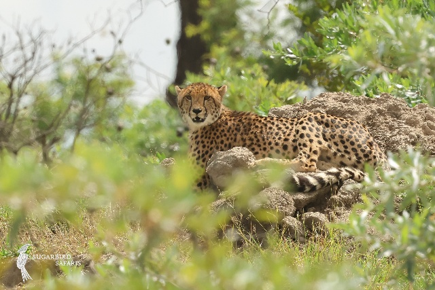
After a short stop in Letaba, we continued towards Phalaborwa at a relaxed pace. The heat was building quickly again, and wildlife activity dropped noticeably as the day progressed. While stopped briefly for a Red-crested Korhaan, a ranger pointed us towards a pair of cheetahs reported a few kilometers away on a termite mound. After some careful searching, we eventually located a single individual, tightly tucked away in dense bush. We had arrived just in time, within a minute it rose, stretched, and melted silently back into the shade.
Not long after, we left the park, restocked supplies in town, and began the long drive north towards Punda Maria. Roughly three hours later, we re-entered Kruger once again. The highlight along the way was a pair of Grey-headed Parrots perched high in a dead tree, a brief but beautiful encounter.
The final hour of the day was spent walking slowly through camp. Despite the heat, a few new species still made themselves known, including Crowned Hornbill and Retz’s Helmet Shrike. Eventually, we surrendered to the conditions, settled onto the terrace, and fired up the braai, the perfect end to another long but rewarding day in the park.
 |  |
Giraffe | Verreaux’s Eagle Owl |
 |  |
Cheetah | Montagu’s Harrier |
Day 17 – 7 March 2026
The day started off rainy, and it didn’t look like it was going to clear anytime soon. As a result, we took a slower pace than usual that morning. Around seven o’clock we eventually set off towards the Luvuvhu River. Crook’s Corner and Pafuri were unfortunately inaccessible due to high water levels, but that didn’t dampen the mood. Barely fifteen minutes into the drive, three cats suddenly crossed the road at speed. One of them even paused briefly, just long enough for us to confirm Cheetahs.
Gradually, the light drizzle eased and the landscape began to dry out. At the same time, more and more baobabs started appearing among the mopane woodland, always a good sign that we were nearing the Pafuri region. The first new species of the morning was a Meves’s Starling. On the bridge over the Luvuvhu River we stepped out to scan the surroundings. A Yellow-billed Stork was dozing on a sandbank, while an African Fish Eagle kept watch from a bare branch above the river. Overhead, dozens of Little Swifts cut through the sky, each one carefully checked for the hoped-for Bohm’s Spinetail, but it was not to be. Further along we heard several Icterine Warblers singing and occasionally spotted two Mosque Swallows darting around distant baobabs. Then, suddenly, Gijsbert thought he saw a rat dart into the grass. When it reappeared, it turned out to be a Four-toed Sengi. To our surprise it showed no fear at all and allowed us excellent views, a real bonus sighting. At the usual stakeouts for Racket-tailed Roller we came up empty-handed, but the Arnot’s Chats obliged and showed well. A juvenile Greater Spotted Cuckoo became the final new species before we turned around and began the drive back towards Punda Maria.
We opted for a gravel road on the return journey, and it proved to be an excellent decision. The winding track led us through dramatic scenery, small streams, and towering baobabs. European Bee-eaters and Southern Carmine Bee-eaters added splashes of color to an otherwise grey day. While watching a Martial Eagle perched in a dead leadwood, a Shaft-tailed Whydah suddenly appeared in a nearby bush. Before we could fully appreciate it, a passing vehicle flushed the bird, and it vanished again. At yet another roadside puddle, we disturbed an African Rail while rounding a bend. We quickly repositioned the vehicle, and within a minute the bird reappeared. Completely unconcerned it gave us several minutes of superb, open views. A perfect ending to a day that, in the morning, we had already written off.
 |  |
Greater Spotted Cuckoo | Four-toed Sengi |
 |  |
African Crake | Martial Eagle |
Day 18 – 8 March 2026
Although the rain had cleared during the day before, it returned in the course of the evening. By the time we woke up, drops were already tapping on the roof, and everything pointed towards yet another grey and drizzly day. It was a slow start. We skipped the planned morning program entirely and headed straight for our next destination: the Magoebaskloof. The drive itself was a constant rhythm of drizzle and heavier downpours as we gradually made our way towards Tzaneen. Since we were in the area anyway, we decided to make a detour to a well-known Bat Hawk stakeout. Almost fittingly, the rain stopped just as we arrived. But any sense of relief was short-lived. Where a productive plantation once stood, a regular roosting site for the birds, there was now nothing more than a clear, open patch of land filled with stumps and cut branches. The entire site had simply been erased.
Still determined not to leave empty-handed, we pushed on to a nearby waterfall where Mountain Wagtail is usually a reliable presence. Conditions, however, were far from ideal. The river thundered down in full force, with most rocks and feeding ledges completely submerged. Not exactly promising. While we took a few tourist-style photos and mentally processed yet another setback, a small movement suddenly caught our eye. A bird appeared on one of the few exposed rocks. And then another. Within moments, we were looking at not one but two Mountain Wagtails, a complete turnaround. A species that had felt impossible just minutes earlier was now giving us excellent photographic opportunities. As if the day hadn’t already delivered enough twists, a clear call suddenly echoed from the canopy as we reached the exit gate, African Emerald Cuckoo. Just as we were about to greet the guards, we abruptly pulled over, leaving them visibly confused. Rein quickly picked up the bird, managed a few record shots, but before everyone could get onto it properly, the cuckoo slipped back into the forest.
Day 19 – 9 March 2026
At 06:00 sharp we picked up our final local guide for the trip. There was no time to waste and as soon as everyone was on board, we set course for the Woodbush Forest. With a full day ahead and an ambitious target list, it was clear from the start that this would not be a slow-paced morning. The forest immediately delivered. One of the first highlights came in the form of a busy mixed-species flock, including Black-fronted Bushshrike, Yellow-streaked Greenbul and Yellow-throated Woodland Warbler moving actively through the canopy. While we were still absorbing this opening wave of activity, the forest suddenly filled with calls overhead, Cape Parrots. After some patience and careful scanning, we eventually managed brief but excellent views of two individuals. Further along, the momentum continued with Olive Woodpecker and Cape Batis adding to the list. A targeted search for Orange Ground Thrush came up empty, but the forest quickly compensated with a beautiful pair of Wood Owl and a Knysna Turaco showing well among the dense greenery. Even around the vehicles, activity never really slowed down, with Red-backed Mannikin, Southern Double-collared Sunbird and Forest Canary all making appearances. It was clear the forest still had plenty to give.
From there, we moved down into the lower-lying areas around Tzaneen. At a plantation on the edge of town, we were treated to an unexpected highlight: a juvenile Crowned Eagle perched near its nesting area. Another long-standing target, Abdim’s Stork, was still on the list, but a visit to the local landfill only produced large numbers of Marabou Storks, despite careful scanning, the target remained elusive.
On the other side of town, the pace picked up again. A Blue-billed Wood Dove appeared quickly, a small and localized species in South Africa and always a good find. A small, remote gravel road then proved surprisingly productive, delivering Purple Indigobird, Magpie Mannikin, Yellow-fronted Tinkerbird and Kurrichane Thrush in quick succession.
After the earlier disappointment with Bat Hawk, there was still one final opportunity. The guide knew of a lesser-known private stakeout with a near-guaranteed chance. After checking in at the gate and a short drive onto the property, it did not take long before a juvenile Bat Hawk was in the scope. And as if on cue, while we were still watching it, an Eurasian Hobby swept overhead as a bonus. It was a fitting end to a day packed with action, new species, and a constant stream of unexpected highlights right up to the final moment.
 |  |
Mountain Wagtail | Bat Hawk |
Day 20 – 10 March 2026
It started off on a difficult note. Paul had been feeling under the weather for a few days, so we made a quick stop at the local doctor while Rein and Gijsbert tried their luck in the garden of the accommodation. It didn’t take long before the diagnosis was clear, a tick bite and antibiotics were prescribed. Not ideal, but at least there was clarity.
There was no time to dwell on it. The bags were packed once more, and we set off towards our final destination of the trip: Zaagkuilsdrift. After a highly successful day in the Magoebaskloof, we were sitting on 447 species, and with a completely new habitat ahead of us, grasslands, wetlands and open savanna, there was still plenty of anticipation in the air. The moment we left the highway and turned onto the 23-kilometer gravel road, things immediately came alive. The roadside bushes seemed to be overflowing with birds, and in almost every patch of cover there was a Marico Flycatcher 448. During a short stop, a sharp call cut through the air, Crimson-breasted Shrike. A brief search later, and there he was in full view 449. And just when things couldn’t get better, five Southern Pied Babblers appeared in the same bush. That was it: number 450. The milestone was reached with still a day and a half to go.
The final stretch towards the lodge is famously known as “Crake Road”, a legendary stretch among birders. After rain, or even just a few puddles, African Crakes can sometimes appear to bathe along the roadside. Conditions weren’t perfect, but the drive still delivered. Grey-headed Kingfisher, Scaly-feathered Weaver and Violet-eared Waxbill added flashes of color along the way.
Before dinner, we returned once more towards Crake Road. The roadside fencing
here is known to attract owls, and soon enough we were watching several
Black-backed Jackals moving along the track.
At one of the puddles, a Marsh Owl was seen

quietly drinking at the water’s edge. Almost back atthe lodge, it briefly felt like we had just missed out again when a smaller owl with a striking white facial disc appeared on the fence. Not quite the confirmation we were hoping for…
until dinner started. Just beside the restaurant, a call suddenly echoed from the trees. We stepped outside, scanned the branches and there he was: Southern White-faced Owl
a stunning Southern White-faced Owl.
Day 21 – 11 March 2026
The evening before, we had put together a perfect plan for our final day, but it unraveled early. When we reached the vehicle, we were greeted by a flat tyre. As if that wasn’t enough, the spare had also been poorly repaired. Suddenly we were standing there with two flat tyres and a carefully planned day rapidly falling apart. Fortunately, the ever-helpful lodge owners immediately stepped in. We were given one of their tyres to use, while they took our damaged wheels to the workshop. As we fitted the borrowed tyre, Gijsbert was practically bouncing around the car. “The last time we started a day like this, it turned into an incredible one!” he kept repeating.
And as it turned out, he might just have been right. Barely on Crake Road, the very first sighting stopped us in our tracks: a stunning female Greater Painted Snipe, just a few meters from the vehicle. Completely unfazed by our presence, she moved slowly along the water’s edge, offering prolonged, intimate views of one of Africa’s most captivating waders.
In the previous days, a River Warbler had occasionally been reported from the Ngomo Ngomo floodplain, so we made a brief detour to try our luck. The heat was already building quickly, and since it was not a new species for anyone, we moved on after we saw a Common Whitethroat. A good call in hindsight, as a little further on we found several juvenile Lesser Moorhens right next to the road, along with our first and only Little Egrets of the entire trip. On a heavily grazed plain, we then tried for Temminck’s Courser, a species that favours exactly this kind of open habitat. Crowned Lapwings, Red-capped Larks and Black-winged Pratincoles were everywhere, but no courser could be found. Splitting up to cover more ground paid off again when Gijsbert called us over, he had picked up an odd-looking pratincole among the flock. Photos confirmed it as a juvenile Collared Pratincole, a rare inland record. Back at the vehicle, another surprise awaited us: a pair of Temminck’s Coursers had finally revealed themselves, tucked away beneath a small bush at the edge of the plain.
From there, it was unfortunately time to set course for OR Tambo. And so, 21 unforgettable days came to an end, a journey filled with laughter, unexpected twists, remarkable encounters, and an incredible total of 467 bird species and at least 47 mammal species. But more than anything, it was a trip packed with memories that will stay long after the checklist is forgotten.
 |  |
Grey Crowned Crane | Eastern Bronze-naped Pigeon |
 |  |
Southern Banded Snake Eagle | Lappet-faced - & White-backed Vultures |

