Kick off Sugarbird Safaris
- sugarbirdsafaris
- Jul 1
- 15 min read

Updated: Aug 13

Day 1 8/10/2025 Kick off Sugarbird Safaris
When Gerda and Leo stayed with us at Paradise River Lodge last year and heard that we were in the process of setting up a travel company specialising in birds, wildlife and photography, they didn’t have to think twice. Almost in unison they said: “We’ll be your first guests!”
Not long after, the plans were laid out on the table. We quickly agreed on both the route and the target species: the elegant Serval, the iconic Cheetah and the almost otherworldly Pennant-winged Nightjar. Above all, there was one overarching goal: to see and photograph as many new species as possible. With the route mapped out and expectations running high, the anticipation could truly begin.
On 8 October the moment finally arrived. At exactly 06:30, Gerda and Leo walked into the reception of their hotel, officially marking the start of the very first Sugarbird Safaris tour. Our journey kicked off at Marievale Bird Sanctuary, a watery mosaic of reedbeds and grasslands just south of Johannesburg. It didn’t take long before the first species were added to the still pristine checklist: Brown-throated Martin, Black-chested Snake Eagle, Black-backed Night Heron and Long-tailed Widowbird.
Marievale was in perfect condition. Along the reed fringes were nutrient-rich mudflats, ideal for rails and waders. From the hides, a lively scene unfolded with impressive numbers of Little Stints, Ruffs, Black-winged Stilts and Black Crakes, complemented by both Lesser and Greater Flamingos. A shy Yellow Mongoose scurrying along the edge of the path became the very first tick on the mammal list.
By around 11:00, the first photographs were safely stored on memory cards and it was time to set course for our first accommodation: a cosy wooden log cabin perched high against a mountainside at roughly 2,300 metres above sea level, right in the heart of Golden Gate Highlands National Park.
We arrived in the park around 15:00 and, after a somewhat sluggish check-in, continued slowly towards our lodge. Along the way we were given an immediate taste of what this area had to offer. Red Hartebeest, Black Wildebeest, Blesbok and Springbok all made appearances, rapidly expanding the mammal list.
After unloading the luggage, firing up the Weber and settling down on the balcony — with breathtaking views over the vast mountain slopes — the day was made complete for Gerda. At the foot of the mountain, a group of Eland appeared, to our great delight accompanied by a calf. Not long after, a Smith’s Red Rock Hare provided the final sighting of the day.
With a crackling braai, a well-earned drink in hand and dusk slowly settling in, a day that could hardly have started any better came to an end — the perfect conclusion to a highly successful first day.
 |  |
Greater Flamingo | Long-tailed Widowbird |
Day 2 09/10/2025 Highlights and Setbacks
The alarms ripped us from our sleep in the early hours, but it was a small price to pay for what awaited us. From our accommodation, a sunrise unfolded that was almost beyond words. Steep mountainsides basked in the first light of the day, slowly turning to gold. With a steaming cup of coffee in hand, we watched as a Smith’s Red Rock Hare joined us, seemingly unwilling to miss a single moment of the spectacle. On the other side of the valley, the full moon silently slipped behind the peaks.
Before setting off for Underberg, we lingered a little longer, soaking in the life around the lodge. Grey-winged Francolins rustled through the grass, Cape Rock Thrushes posed beautifully, and Buff-streaked Chats and Ground Woodpeckers kept us constantly distracted. Eventually tearing ourselves away from the splendour, we hit the road, only to have multiple vultures circle overhead at the local “vulture restaurant,” riding the thermal updrafts.
During the walk to the hide, an unexpected highlight unfolded: a Bearded Vulture in its third calendar year suddenly glided between the Cape Vultures. Unfortunately, the bustle of day-trippers seemed to spook him almost instantly; without hesitation, he took to the sky and disappeared as suddenly as he had appeared.
As if the adventure hadn’t already taken enough twists, a minor drama played out in the hide. Gerda’s camera slipped from the railing and smashed onto the ground — the end of the story. No matter how hard we tried to resurrect it during the drive, it was beyond repair. With a mix of resignation and determination, a solemn promise was made: Gerda would now do everything in her power to find a serval. It was clear that this story was far from over.
 |  |
Blesbok | Southern Bald Ibis |
Day 3 10/10/2025 Breathtaking Sani Pass
In the early hours, Stuart McLean pulled up — our guide for the day. With a few stops along the way, we were gradually eased into the challenge that awaited: the climb up Sani Pass. The species list steadily grew, and before long we were photographing Dark-capped Yellow Warbler, Red-throated Wryneck, Malachite Sunbird and Gurney’s Sugarbird. Here, it’s not the baboons you need to watch during a coffee break, but the Buff-streaked Chats, trying to snatch your rusks straight from your hands.
At the South African border post at the foot of the pass, African Paradise Flycatchers and African Dusky Flycatchers put on a little show just for us. The climb along the 4x4 gravel road, full of hairpin bends, rewarded us with spectacular vistas, while a playful troop of baboons added extra entertainment. Once we passed the Lesotho border post, the birding truly took off, with one new species after another for Gerda and Leo: Drakensberg Siskin, Sentinel Rock Thrush, Mountain Pipit and Sickle-winged Chat, to name just a few. Even a Sloggett’s Ice Rat made a surprise appearance.
Two Bearded Vultures circling overhead during our lunch break, along with a pair of Ground Woodpeckers, provided a delightful distraction.
One of the target species for Sani Pass and the Drakensberg is the Drakensberg Rockjumper. As the day went on, our hopes began to sink — until, during the descent, a male suddenly darted past the car. We pulled over quickly and searched! Luckily, it didn’t take long before we could observe him beautifully, before he vanished again as suddenly as he appeared.
At the foot of the mountains, the weather had thankfully cleared, and one final target remained on the agenda: one of Stuart’s specialties, the Buff-spotted Flufftail. Just as we were about to give up hope and head back to the car after about twenty minutes, a male appeared like a little imp out of a box. He revealed himself for precisely thirty seconds before disappearing back into the bushes.
 |  |
African Paradise Flycatcher | Buff-streaked Chat |
 |  |
Drakensberg Rockjumper | Buff-spotted Flufftail |
Day 4 11/10/2025 Dancing Cranes
Before setting off for St. Lucia, we explored a few quiet backroads in search of cranes. Within minutes, we were face-to-face with a pair of Grey Crowned Cranes — stately and elegant — that suddenly began a graceful dance, wings outstretched and heads moving rhythmically up and down. Still in awe, we continued along the road, only to stop again a few hundred meters later. There, a group of Blue Cranes performed their own morning dance, just like their golden-crowned relatives, illuminated by the soft light of the early sun. As if that wasn’t enough, a family of the rare Wattled Cranes in a nearby marsh provided a perfect finale to this crane spectacle.
A few hours later, we arrived at our accommodation in St. Lucia. After a brief rest, we were picked up for a boat tour along the lagoon. We encountered several family groups of hippos, lazily drifting in the water, eyes and ears barely above the surface, ccasionally exhaling ith a soft snort. An African

Finfoot briefly appeared but disappeared
almost as quickly into the reeds before we could properly admire it. Meanwhile, the reeds seemed to dance themselves: little weaver birds flitted from stem to stem, busily building their nests, while the sunlight brought the swaying stalks to life.
Grey Crowned Crane
Day 5 12/10/2025 Morning Magic on the Eastern Shores
At precisely 06:00, we entered the Eastern Shores of the iSimangaliso Wetland Reserve, and it immediately promised to be a special day — highlights came in rapid succession. At our first stop, we watched three rare Rufous-bellied Herons, slowly waking up just like the rest of nature. Across the road, White-backed Ducks, African Pygmy Geese and Black Crakes quietly foraged among the pale purple lilies. At a small puddle, swallows returned repeatedly to collect mud for their nests, while various butterflies flitted through the fresh green landscape, adding vibrant accents to the lush surroundings.
Birds of prey were also abundant: a majestic Crowned Eagle, Southern Banded Snake Eagle, Brown Snake Eagle, and a pair of African Cuckoo Hawks, busy teaching their older chick the art of hunting. A small herd of buffalo provided the first tick on our Big Five list for the trip.
After lunch, we went on a short night drive and discovered four curious genets. Back at our lodge, we caught a glimpse of what makes St. Lucia so famous: hippos casually wandering the streets in search of the juiciest patches of grass.
 |  |
Cape Buffalo | African Pygmy Goose |
Day 6 13/10/2025 A Promise Kept
Just like the day before, we entered the iSimangaliso Wetland Reserve at 06:00, this time via the Western Shores. The morning was cool and quiet — until around 07:00, when everything suddenly exploded into action. Gerda nearly tested the airbag as she spotted a serval digging something out of the ground right beside the road. Without a moment’s hesitation, the cat struck, snatched its prey, and sprinted some seventy meters back into the field, vanishing seamlessly into the tall grass. All of this happened before the car had even come to a complete stop.
A few more times, the serval appeared above the grass, leaping gracefully, fully focused on hunting its next snack. The promise had been fulfilled! The rest of the morning was already set to be unforgettable, with spectacular sightings of Black-bellied Bustard, a brilliantly coloured Malachite Kingfisher, Broad-billed Rollers, Green Malkoha, and even a Narina Trogon.
In the afternoon, as we entered uMkhuze, our reflexes were put to the test. A Green Mamba decided to cross the road right in front of our car, prompting the first emergency stop of the day. After check-in and unloading, we took a gentle exploratory drive through the reserve and visited a hide. Here, a small nature drama unfolded: a Natal Green Snake had just caught a frog and was slowly working it down. As a perfect finish to an already successful day, a shy pair of Pink-throated Twinspots made a brief, colourful appearance among the greenery.
 |  |
Serval | Natal Green Snake |
 |  |
Narina Trogon | Green Malkoha |
Day 7 14/10/2025 A Day of Rhinos
After a few remarkable sightings, including a hunting Eurasian Hobby and a stately Wahlberg’s Eagle, it was once again Gerda who struck just after 07:00. About a hundred meters away, half-hidden behind thick bushes, stood a Black Rhinoceros. An absolutely breathtaking moment. As so often with these elusive giants, the encounter was fleeting: less than a minute later, he silently disappeared into his favourite hideout, the impenetrable bush. It felt almost like releasing a genie from a lamp, with all wishes being granted in a single instant.
Apart from a small group of elephants — our third tick on the Big Five list — the rest of the morning was surprisingly quiet. During the warmer hours, we slowed the pace, taking a moment to recharge while the landscape itself seemed to doze under the sun.
The afternoon, however, began with a confronting and somber scene on the other side of the reserve. Winter fires had left a trail of destruction: charred earth, blackened bushes, and an eerily silent environment. Leopard Tortoises had been particularly hard-hit, their numbers alarmingly reduced.
Just as we left a herd of buffalo behind and continued slowly, the day brought hope again. Among the bushes appeared another rhino — this time a White Rhinoceros, accompanied by a calf only a few months old. A truly moving sight. And what a privilege it is to witness both black and white rhinos still roaming here with their horns intact, thanks to the tireless efforts of successful anti-poaching teams. A powerful reminder that protection truly makes a difference.
 |  |
Black Rhinoceros | White Rhinoceros |
Day 8 15/10/2025 Farewell uMkhuze and Into Kruger
In the early hours, as we loaded our bags into the car, Red-chested Cuckoos literally buzzed around us. A few quick photos later, we spent some precious hours in the park before it was truly time to leave. The camp was still visible in the rearview mirrors when, suddenly, two Side-striped Jackals emerged from the bushes. They seemed to have a den in a drainage pipe under the road, busily investigating the area, and the female’s teats were clearly visible.
Along the way to the park exit, we stopped multiple times: first for a large elephant, then — likely the same buffalo herd we had seen earlier — and later for a magnificent pride of lions with a few older cubs.
From uMkhuze, we drove straight to Crocodile Bridge to enter the famous Kruger National Park. Thankfully, the border crossings through Eswatini went smoothly, and within three hours we were back in South Africa. A quick stop in Komatipoort for essentials, and soon we were driving back into Kruger.
Since a night drive was planned for that evening, we headed straight to Lower Sabie for some rest. On paper, it was a perfect plan — but in the park, reality had other ideas. One moment, we were face-to-face with elephants and lions in uMkhuze; the next, we found ourselves alongside a massive elephant herd and a lone lioness in Kruger.
And the birds, of course, kept us on our toes: Crested Barbets, Southern Yellow-billed Hornbills, the charming African Firefinch, and the awe-inspiring Martial Eagles, claws massive and menacing. By the time we reached camp, the chance to rest was fleeting — but it was more than made up for by a lion pair mating just beside the road.
 |  |
Side-striped Jackal | Lion |
Day 9 16/10/2025 A Day of Cheetahs and Cubs
In Kruger, sleeping in is simply not an option. Even before the alarms went off, we were packed and ready, brimming with anticipation. Naturally, we weren’t the first at the gate; there are always those relentless early risers, determined to be the first inside.
The plan was clear and ambitious: today, we were hunting cheetahs. When a couple coming the other way informed us that three cheetahs were just a few kilometres ahead on the road, tension shot through the vehicle. The accelerator went down a notch, conversation fell silent, and soon we were face-to-face with three brothers. From a slight rise, they surveyed the world around them, elegant and alert — true rulers of the plains.
After a well-earned coffee stop and some adrenaline subsiding, we were free to simply enjoy the moment: the subtle beauty of a Blue Waxbill, a Dwarf Mongoose scuttling along, and the heart-racing appearance of two lion cubs suddenly beside the car — curious, playful, and only a few metres away. A few hundred meters beyond, we spotted another lion pair. After about ten minutes, the lioness stood, quickly followed by the male. Moments later, she settled back down, and he wasted no time — mounting her in a brief, twenty-second display before both returned to their snooze mode, as if nothing had happened.
The hours slipped by unnoticed. Only when the sky began to close in from all sides did we realize how late it had become. Dark clouds gathered, and the atmosphere of the landscape shifted. At every waterhole, elephants seemed to pick up some invisible signal; one by one, they hurriedly left the water. Not long after, the heavens opened, and a massive thunderstorm swept across the park. The planned night drive was, understandably, called off.
 |  |
Cheetah | Martial Eagle |
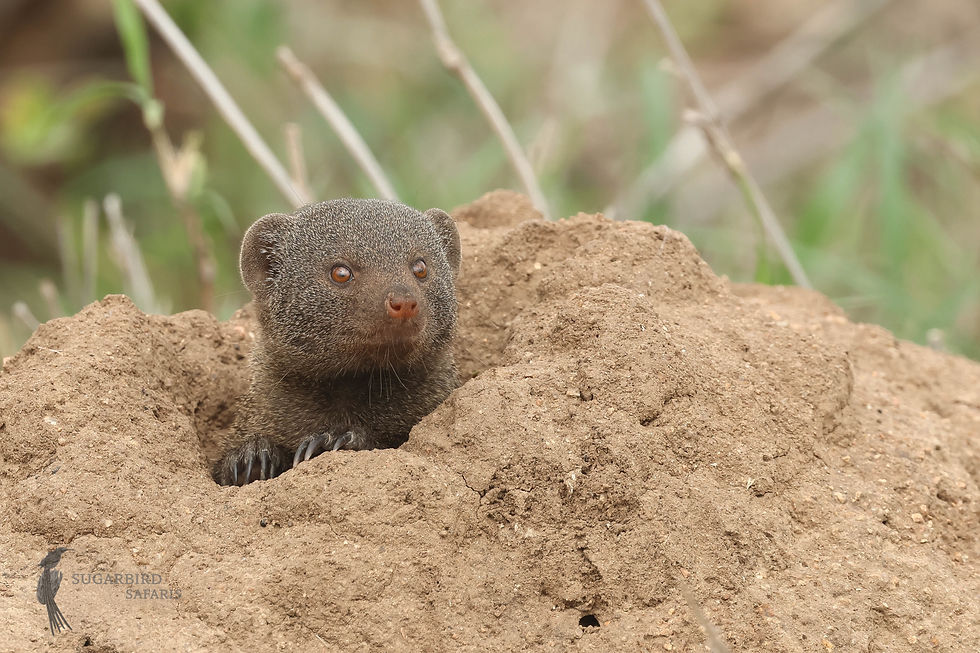 |  |
Dwarf Mongoose | Hippopotamus & Grey Heron |
Day 10 17/10/2025 A Day Full of Surprises
We couldn’t have imagined a better start to

the day. Just before our arrival, a young male Leopard had caught an Impala and was locked in a battle with his own inexperience. Determined, he tried again and again to drag his prey up a tree, but the weight was too much.
Time and again, he leapt into the tree, clamped onto the carcass, slipped, jumped back down, took a few quick bites, and tried again. At times, out of sheer frustration, he even climbed the tree empty-handed. The news of this sighting must have spread like wildfire. In no time, the road was crowded with vehicles. With a long drive ahead to Letaba, we decided to let the spectacle go and continue on. Only a few hundred meters further, almost ironically ignored, a juvenile African Fish Eagle perched proudly high in a tree, clutching a freshly caught fish in its talons.
Midway, we made a brief stop at a hyena den when another vehicle pulled up alongside us. The window rolled down, and almost casually, the words were uttered: “Wild Dogs… with pups.” We tried to forget it — after all, wild dogs can cover tens of kilometres in a day, and the location was still far ahead. But the thought lingered. After a few minutes, we continued cautiously, until three enormous elephants suddenly blocked the road, forcing us to a complete stop.
Our astonishment grew when, just over an hour later, we came face-to-face with the pack: ten adult wild dogs and two playful pups. The youngsters bounced through the group, chasing each other and teasing each adult in turn, creating endless entertainment.
For our afternoon safari, we decided on a short walk around the camp in search of owls. Luckily, we didn’t have to look long. An African Barred Owlet called loudly, and we only needed to follow the sound. Halfway up a Mopane tree right beside the path, it perched completely exposed, undisturbed, and let itself be photographed beautifully. As if that weren’t enough, a Golden-tailed Woodpecker and a Brown-hooded Kingfisher joined him in the same tree.
Even during the drive, there was never a dull moment. In the middle of the gravel road, a mother hyena lounged with her three cubs, relaxed as if she had claimed the entire stretch. A sighting all to ourselves. Just as we decided to head back toward camp, a massive bull elephant appeared several hundred meters ahead, moving straight toward us. Minute by minute, he drew closer. We waited, the world seeming to stand still. Then, just as he was about to emerge from the tall grass, he suddenly changed direction and disappeared into the dense vegetation.
 |  |
Wild Dog | Golden-tailed Woodpecker |
 |  |
African Barred Owlet | Spotted Hyena |
Day 11 18/10/2025 The Final Target at Dusk
Today had to be the big day. This afternoon, during a sundowner drive, we would be on the hunt for the final one of our three target species: the Pennant-winged Nightjar. But where the previous days had begun so promisingly, this morning crept along sluggishly. The air hung heavy over the landscape, as if nature itself had no hurry to wake. Relief was immense when, after nearly two hours of driving, we came across a group of Southern Ground Hornbills by the roadside, calmly searching for their breakfast. Even they seemed to have to work for it.
The rest of the morning was dedicated to birds, as larger wildlife was scarce. We recorded species including Tawny Eagle, White-backed Vultures, and an African Harrier Hawk.
During a short stop at Shingwedzi to stretch our legs and grab a cold drink, we noticed a few vehicles across the camp. Curious, we took a quick look before continuing north. In a dry riverbed right below the road lay a crocodile at least three meters long, gripping a dead impala firmly in its jaws. Around the scene, a circle of vultures had gathered, including two Lappet-faced Vultures — the largest vultures in South Africa and a new addition to our trip list. The crocodile seemed to hold the carcass deliberately, guarding it against the persistent scavengers. With little movement, we continued on our way.
After a well-earned afternoon rest, the moment we had been waiting for all day finally arrived: the search for the Pennant-winged Nightjar. Full of anticipation, we climbed into the back of the game viewer. We were told we would only attempt the nightjar if everyone in the group was interested. A non-birding American passenger was quickly convinced — when I showed him some photos, he explained that he had seen the bird in pictures before the trip and had assumed he would never see it in real life. No persuasion was needed.
As the sun slowly sank below the horizon, the ride seemed endless. Finally, the Land Cruiser stopped, we stepped out, and the wait began. Within minutes, a soft, high-pitched, insect-like twittering came from a distance. It grew closer and closer. And then it happened. An adult male shot straight between us, its long decorative wings brushing through our hair at times. It quickly became too dark for cameras, which we laid aside without hesitation. This was a moment not to capture, but to fully experience. Silent, breathless, and with goosebumps, we savoured the magic in its entirety.
 |  |
Nile Crocodile with Impala | Pennant-winged Nightjar |
Day 12 19/10/2025 A Successful Kickoff
On the return from our night drive the previous evening, the wind suddenly picked up fiercely. The SANParks tents we had slept in were in lamentable condition; everything rattled and creaked, and more than once we wondered in which camp we would wake the next morning. To make matters worse, around 1 a.m., a thunderstorm broke right next to my tent, shortly followed by a tropical downpour.
What should have been a beautiful finale to the trip turned into a nightmarish ordeal for Gerda and Leo. Their tent was far from waterproof, and soon their clothes were literally floating inside their suitcases. Fortunately, a few days of relaxation awaited at Paradise River Lodge, where everything could be dried. Without hesitation, we loaded everything into the car and left the wet chaos behind.
Along the road, two drenched Black-backed Jackals made for another striking addition to our now impressive checklist. A little further on, we spotted a family of Southern Ground Hornbills, with the male proudly showing off his catch: two frogs dangling from his beak. A pair of Red-billed Oxpeckers on an Impala’s back had no interest in food this time, busily gathering nesting material instead.
Just before exiting the park at Phalaborwa, we paused to watch a pair of Klipspringers. For a change, they were not high up on a rocky slope but lying relaxed right beside the car, calmly chewing and observing their surroundings. In a bush nearby, a Little Bee-eater was having its moment, feasting on the first insects of the season stirred up by the rains. Three Greater Painted Snipes scurrying along a creek became our very last sighting — a fitting finale to a highly successful inaugural trip for Sugarbird Safaris. Content, we drove out of the park, heading toward Paradise River Lodge.
 |  |
Southern Ground Hornbill | Klipspringer |
 |  |
Red-billed Oxpecker on an Impala | Little Bee-eater |

